By Lucila Sigal
BUENOS AIRES, April 1 (Reuters) - An Argentine-built microsatellite, the only one from Latin America selected for NASA's return to the moon, will test experimental navigation systems and measure radiation far beyond Earth's orbit when it flies on the Artemis II mission.
The shoebox-sized satellite, known as ATENEA, is one of four international payloads chosen by NASA from proposals submitted by nearly 50 countries to accompany Artemis II, the first crewed lunar mission in more than half a century, which was scheduled to lift off later on Wednesday. The others are from Germany, Saudi Arabia and South Korea.
Developed by the engineering faculty at the University of Buenos Aires, with support from Argentina's national space agency CONAE and other scientific institutions, ATENEA will travel roughly 72,000 kilometers (44,739 miles) from Earth, well beyond the planet's protective magnetic field.
Argentina's project director Fernando Filippetti said the mission offers a rare chance for Argentine scientists to study conditions in deep space, where radiation levels are far higher and more volatile than in low-Earth orbit.
"Even though Argentina is better known for football, our space agency CONAE has built satellites of extremely high complexity, of world-class standard," Filippetti said, speaking by phone from Cape Canaveral, Florida.
The satellite will focus on measuring radiation exposure and test whether faint signals from Earth's GPS satellites can be harnessed to navigate far from the planet.
"This represents a unique opportunity to test and measure parameters in deep space," Filippetti said.
ATENEA will attempt to capture data with the aim of laying the groundwork for a future space-based GPS capable of determining a spacecraft's position far from Earth.
Argentina's space sector had quietly developed technology of global standard, despite limited resources, Filippetti said.
Libertarian President Javier Milei's government has sharply cut public spending since taking office in late 2023, with funding reductions hitting many state institutions, including CONAE.
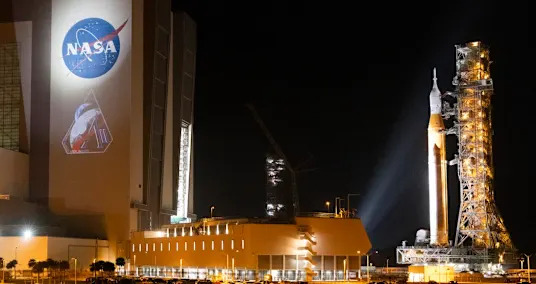
NASA's launch with four astronauts will begin a 10-day flight around the moon, marking the most ambitious U.S. space mission in decades and a major step toward returning humans to the lunar surface before China's first crewed landing.
(Reporting by Lucila Sigal; Writing by Cassandra Garrison; Editing by Bill Berkrot)
latest_posts
- 1
 DEA seizes 1.7 million counterfeit fentanyl pills in Colorado storage unit
 - 2Ariana Grande to host 'Saturday Night Live' Christmas show with Cher as musical guest, returning after nearly 40 years
- 3'Crammed into a cell with vermin at New Year'
- 45 State of the art Advancements in Computer generated Simulation
- 5Hungary's 'water guardian' farmers fight back against desertification


- Help Your Business with Master Web based Promoting Arrangements
- Remains of banker missing since 1999 found on California beach by family looking for seashells
- Bestselling author Colleen Hoover reveals cancer journey
- NASA releases new photos of interstellar comet 3I/ATLAS
- The Most Paramount Crossroads in Olympic History
- NASA wants to build a base on the Moon by the 2030s – how and why it plans to build up to a long-term lunar presence
- Journey through Pages: A Survey of \Plunging into Scholarly Universes\
- I took my shoes off and went for a barefoot hike. I couldn’t believe what happened next
- Chevron Says Damage at Wheatstone LNG Will Hamper Restart