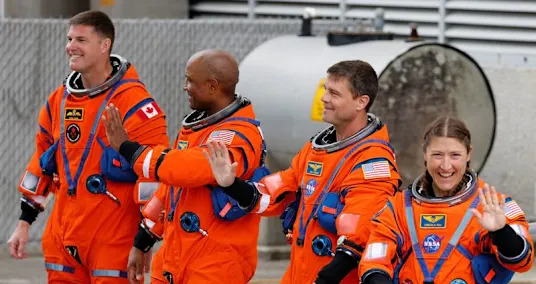
April 1 (Reuters) - All three NASA astronauts on the Artemis II lunar mission are veterans of Earth-orbit science expeditions to the International Space Station, while the lone Canadian joining them on a voyage around the moon and back is a spaceflight rookie.
Here are some highlights from the careers of mission commander Reid Wiseman, pilot Victor Glover and mission specialist Christina Koch, all U.S. astronauts, and Canadian astronaut Jeremy Hansen, also a mission specialist.
MISSION COMMANDER REID WISEMAN
Wiseman, 50, logged 165 days aboard the International Space Station during a 2014 mission, flying to the orbiting platform aboard a Russian Soyuz spacecraft. A former U.S. Navy test pilot, he later served as NASA's chief astronaut before being selected to command Artemis II.
PILOT VICTOR GLOVER
Glover, 49, spent 168 days in orbit beginning in 2020 as pilot of NASA's Crew-1 flight, the first full-fledged ISS mission using SpaceX's Crew Dragon capsule to carry astronauts to the space station. Before joining NASA, he flew more than 40 aircraft during a U.S. Navy career that included combat deployments and test-pilot duties. A veteran of four spacewalks, he is the first Black astronaut ever to be sent on a lunar mission.
MISSION SPECIALIST CHRISTINA KOCH
Koch, 47, set a record in 2019 for the longest continuous spaceflight by a woman, spending 328 days aboard the ISS, and was part of NASA's first three all-female spacewalks. Trained as an electrical engineer and physicist, she previously worked as a NASA engineer and carried out extended research expeditions in Antarctica. She is the first woman to fly on a moon-bound mission.
MISSION SPECIALIST JEREMY HANSEN
Hansen, 50, a Royal Canadian Air Force colonel, is the first Canadian, and first non-U.S. citizen, sent on a lunar mission even as he makes his own first spaceflight. He was selected for Canada's astronaut corps in 2009, and his seat aboard Artemis II reflects a long-standing U.S.–Canadian partnership in human spaceflight, including Canada's contributions to robotics used aboard the ISS.
(Compiled by Joey Roulette in Cape Canaveral, Florida and Steve Gorman in Los Angeles; Editing by Jamie Freed)
latest_posts
- 1
 We analyzed Philly street scenes and identified signs of gentrification using machine learning trained on longtime residents’ observations
 - 2Iranian missile hit on Ne'ot Hovav factory leads to fear of chemical leakage
- 3Former IRGC child executioner tells ‘Post’ how he became devout Christian dissident
- 4Israel violated ceasefire with Hezbollah more than 10,000 times, UNIFIL claims
- 5Finding Europe's Head Traveler Objections: An Excursion Through Famous Attractions





- What to know about MIT professor Nuno Loureiro and the investigation into his shooting
- Dr. Vinay Prasad's memo raises concerns about COVID-19 vaccines and pediatric mortality
- Moon rush: These private spacecraft will attempt lunar landings in 2026
- Beating Wellbeing Difficulties: Individual Victories in Health
- The Minimized Passage Horse: Reconsidering a Symbol for the Cutting edge Period
- Most loved Web-based feature: Which Stage Do You Like
- How to watch ‘The Traitors’ U.K. Season 4 from the U.S.
- West Antarctica’s history of rapid melting foretells sudden shifts in continent’s ‘catastrophic’ geology
- Dominating Capable Mastercard Utilization: Key Contemplations


