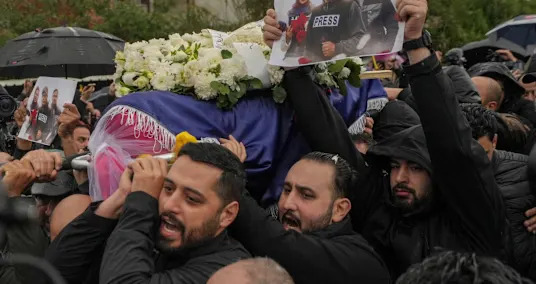
Three United Nations experts have called for an independent and thorough investigation into Israel’s recent killing of three journalists in Lebanon, denouncing the deadly incident as “another egregious attack on press freedom by Israeli forces”.
UN special rapporteurs Irene Khan, Morris Tidball-Binz and Ben Saul on Thursday noted that “journalists carrying out their professional duties in armed conflict are civilians and must not be targeted or made the object of attack”.
“The deliberate killing of journalists not directly participating in hostilities constitutes a serious violation of international human rights and humanitarian law and a war crime,” they said in a statement.
The Israeli military killed Al Mayadeen journalist Fatima Ftouni, her brother, freelance photojournalist Mohamad Ftouni, and Al-Manar’s Ali Shoaib in a targeted strike on their car in southern Lebanon on March 28.
Al Mayadeen and Al-Manar are pro-Hezbollah media outlets, and Israel accused Shoaib – without presenting any evidence – of being a fighter with the Lebanese armed group.
That claim was rejected by Shoaib’s colleagues as well as by the UN experts, who on Thursday also stressed that working for media outlets affiliated with an armed group does not mean journalists are directly participating in hostilities under international law.
“Israeli officials know this, yet they choose to ignore it – emboldened by impunity for their previous killings of journalists in Lebanon, Gaza and the West Bank,” they said.
In February, the Committee to Protect Journalists (CPJ) reported that Israel was responsible for two-thirds of all killings of journalists in 2024 and 2025.
More than 60 percent of the 86 members of the press killed by Israeli fire last year were Palestinian journalists reporting from the Gaza Strip amid Israel’s genocidal war in the coastal enclave, the advocacy group found.
After the killings in southern Lebanon last week, CPJ’s Middle East director Sara Qudah also warned that Lebanon is becoming “an increasingly deadly zone for journalists, despite their status as civilians who must not be targeted”.
“We have seen a disturbing pattern in this war and in the decades prior of Israel accusing journalists of being active combatants and terrorists without providing credible evidence,” Qudah said in a statement.
“Journalists are not legitimate targets, regardless of the outlet they work for.”
The UN experts also warned that Israel’s killing of Lebanese journalists is part of “an abominable push … to silence reporting on Israel’s current military action in Lebanon, and shut down news coverage of war crimes committed, just as it did in Gaza”.
At least 1,345 people have been killed and 4,040 wounded in intensified Israeli attacks across Lebanon since early March, according to the Lebanese Ministry of Health.
latest_posts
- 1
 The most effective method to Go Down Abundance through Ages with Disc Rates
 - 2Asia's migrant workers debate if Gulf jobs are worth deadly risk of Iran war
- 3Language Learning Stages: Which One Gets Your Vote?
- 4Former elite Australian soldier charged with Afghan war crimes
- 5Step by step instructions to Pick A Pre-owned vehicle Stage




- Germany's Deutsche Welle broadcaster declared 'undesirable' in Russia
- Exploring the Main Year of Life as a parent: Individual Encounters
- NASA's Artemis 2 pilot Victor Glover listens to 'Whitey on the Moon' every Monday. This is why.
- Day to day Temporary Positions That Compensate Fairly in the US
- Excursion to Different Universes: the Top Sci-fi Motion pictures Ever
- CDC changes kids' vaccine schedule, removing universal recommendation for some shots
- $1,000 bribes, Mormon momfluencer mixers and making content to get plastic surgery: The wildest things I learned reporting my book
- Don't fall for it: These common tourist scams in Rome are easy to avoid if you know what you're looking for
- German inflation soars to 2.7% in March as Iran war drives up prices