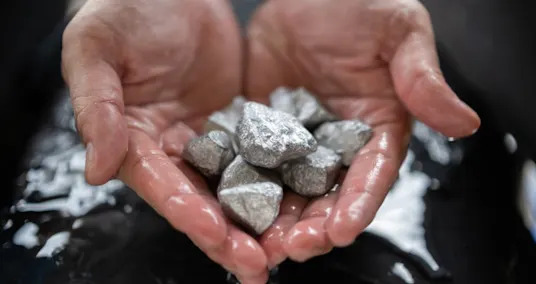

St George Mining Ltd (ASX:SGQ, FRA:S0G, OTC:SGQMF) has delivered its thickest and most compelling drill result yet from the Araxá Rare Earths and Niobium Project in Brazil, with a standout intercept of 178.7 metres at 4.34% total rare earth oxides (TREO) and 0.75% niobium oxide (Nb₂O₅) from surface.
The result — the thickest mineralised interval recorded at Araxá to date — underscores the scale, grade and near-surface continuity of the deposit, reinforcing its status as one of the most significant undeveloped rare earths and niobium projects globally.
It forms part of a broader batch of assay results from 15 diamond drill holes, with multiple wide, high-grade intercepts continuing to demonstrate consistency across the system.

Oblique section showing the latest diamond drill holes as well as other significant drilling completed in the current campaign. The latest drill holes with red labels.
Among the highlights:
-
165.3m at 4.28% TREO and 0.61% Nb₂O₅ from surface
-
150.2m at 4.64% TREO and 0.59% Nb₂O₅ from surface
-
163.65m at 3.29% TREO and 0.45% Nb₂O₅ from surface
-
81.05m at 5.14% TREO and 0.64% Nb₂O₅ from surface
These results continue to highlight a defining feature of Araxá — very thick, high-grade mineralisation starting at surface, supporting the potential for a low-strip, open-pit mining operation.
Section A – A’ showing high-grade TREO intercepts (cut-off 1% TREO) and high-grade Nb2O5 intercepts (cut-off 0.2% Nb2O5) along with the existing MRE outline.
Executive chairman John Prineas said the combination of scale and grade, particularly from surface, sets Araxá apart from comparable projects.
“The drilling results continue to show huge true widths from surface paired with very high grades,” he said.
“This unique combination is unrivalled among emerging rare earths and niobium developers,” he added. “The commercial advantage of high-grade mineralisation starting from surface — as opposed to 50 metres or even more than 100 metres below surface — cannot be underestimated.”
Section B – B’ showing high-grade TREO intercepts (cut-off 1% TREO) and high-grade Nb2O5 intercepts (cut-off 0.2% Nb2O5) along with the existing MRE outline, showing the expansion of the existing MRE.
High-grade system continues to expand
Drilling at Araxá has now been running continuously for more than six months, with the current program designed to both expand and upgrade the mineral resource estimate.
The latest results demonstrate strong grade continuity over broad intervals and suggest further upside, with the mineral system remaining open in all directions and at depth.
latest_posts
- 1
 This Week In Space podcast: Episode 187 — An Inspired Enterprise
 - 2These four astronauts could soon travel farther from Earth than anyone has gone before
- 3Cocoa Prices Undercut Amid the Prospects of Abundant Supplies
- 4A 3-limbed Kemp's ridley sea turtle is now being tracked at sea by satellite
- 5West Palm Beach Shorecrest, renderings of downtown waterfront condo





- Figure out how to Team up with Your Auto Crash Legal advisor for Best Outcomes
- Netanyahu leads meeting on West Bank riots, Katz defends axing administrative detention for Jews
- Attorney-General to High Court: Gov’t violating draft ruling, risking rule of law
- Picking the Right Home Machines: A Commonsense Aide
- Israel and Lebanon's Hezbollah continue to trade attacks
- Bolsonaro discharged from hospital and placed under house arrest
- How a seabird native to Hawaii has adapted to life in Honolulu's concrete jungle
- Monetary Wellness: Planning Tips for Independence from the rat race
- Vote in favor of Your Number one BWM Vehicles